










Now boardingApril 13, 2026
FlyingNeedsRules
Same seat, same flight, same day, two people paid prices that differ by 600%. Here are the rules flying needs.
- Flight
- AG 14
- Seat
- Any
- Flight time
- 5 min
- Bag
- Included

Flying Needs Rules
You book a flight last minute. It's $1,200.
You sit down. Five seats around you are empty.
You just paid for six tickets so the airline could not sell five of them.
That's not a market. That's a hostage situation.
Every other form of transport has rules.
The subway has a fare. You pay it. You ride.
A train ticket includes your seat and your bag. Same with a long-distance bus. Same with a ferry. Same with the Eurostar.
Flying is the only mode of transport where the price of the same seat, on the same day, can swing by 600% depending on when you click "book." Where your bag costs extra. Where your seat costs extra. Where the meal costs extra. Where the airline can sell more seats than the plane has and then bump you off the flight they sold you.
None of this is illegal. That's the problem. There are no rules.
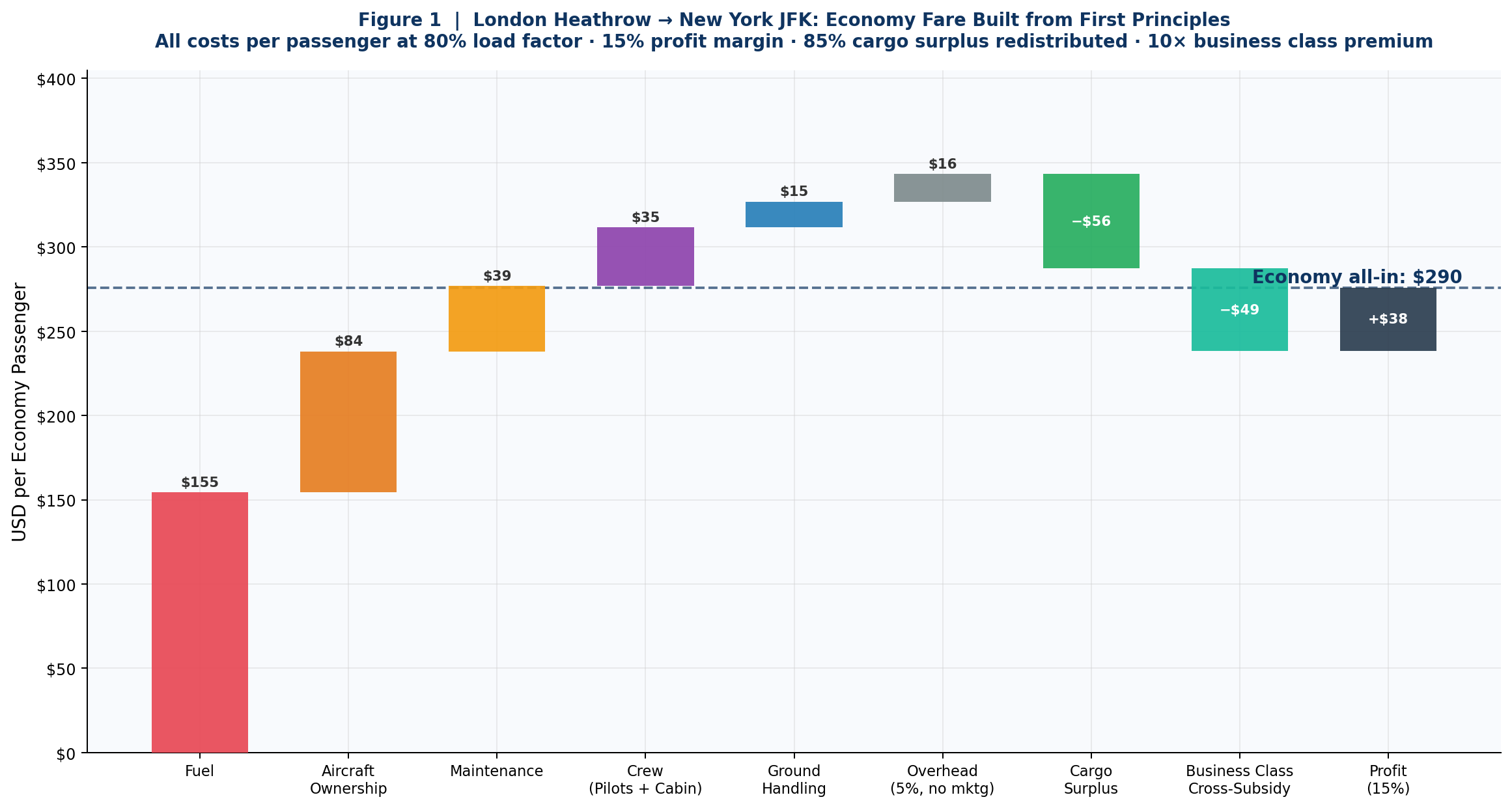
I built a bottom-up cost model for 206 routes across every G20 country. Every cost component calculated from scratch. Fuel, aircraft lease, crew, maintenance, ground handling, overhead. Add a 15% profit margin. That's the fare.
Here's what flying should cost, one-way, all-inclusive (bag, meal, seat, all fees):
| Route | Distance | Should cost | Actually costs |
|---|---|---|---|
| São Paulo → Rio | 356 km | $45 | $120 |
| Seoul → Jeju | 451 km | $51 | $110 |
| Sydney → Melbourne | 706 km | $58 | $195 |
| Delhi → Mumbai | 1,137 km | $68 | $135 |
| New York → LA | 3,974 km | $134 | $320 |
| London → New York | 5,541 km | $290 | $700 |
| Sydney → LA | 12,060 km | $619 | $980 |
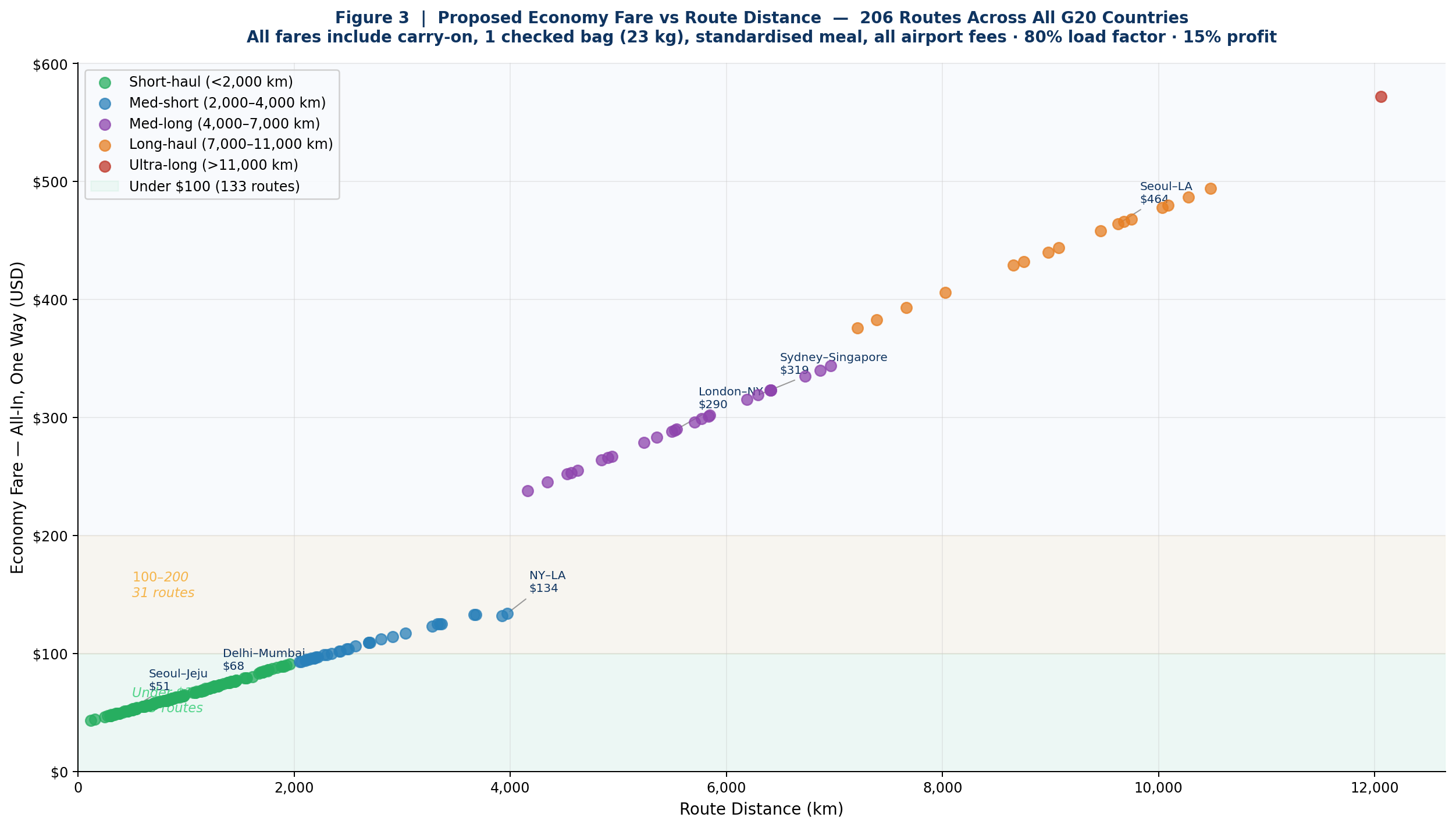
133 of the 206 routes can sustain economy fares under $100 one-way, fully all-inclusive, at a healthy 15% profit margin.
The average across all 206 routes is $131 one-way. The average overcharge per ticket compared to what you actually pay today: $139.
Multiplied across global passenger volumes, people are overpaying about $1.2 trillion a year to fly.
When you pay $700 for a ticket, only a fraction of that pays for actually flying you somewhere.
The rest goes to revenue management departments, which are entire teams of analysts whose only job is to figure out the highest price you'll pay before you give up and book. To GDS distribution fees, which are middleware companies like Sabre and Amadeus that charge $5 to $10 every time a ticket is sold through a travel agent or comparison site. To marketing budgets that spend billions convincing you their seat is somehow different from the other airline's seat. And to loyalty program accounting, which is bigger than you think.
Kill those three line items and the price drops by 30 to 40%. No magic. Just stop paying for things that don't move planes.
- Fuel
- Aircraft lease
- Crew
- Maintenance
- Ground handling
- Overhead
- +15% profit
- Revenue management teams
- GDS fees, $5 to $10 a ticket
- Marketing budgets
- Loyalty programme accounting
Cut three of those line items and the price drops by 30 to 40%.
This is the part most people miss.
In 2020, American Airlines used its AAdvantage program as collateral for a $7.5 billion loan. The program itself was valued at $19.5 billion. More than the entire airline.
Delta's SkyMiles? Valued at $26 billion. Bigger than Delta itself.
American Airlines makes more pre-tax profit selling miles to Citi than from operating flights. Delta gets $7 billion a year from American Express for the right to issue SkyMiles to cardholders. The flying is the marketing. The miles are the business.
And the miles themselves are a Ponzi scheme.
Not in the legal sense, nobody's going to jail. But structurally. Banks buy miles from airlines at about 1.5 cents each. The airline books the cash as revenue immediately. The miles become a "liability" on the airline's balance sheet, but the airline controls how much they're worth. Over time, the airline quietly raises the redemption cost. What used to be 25,000 miles becomes 75,000 miles. Same flight. In 2023, American Airlines just deleted their award chart entirely. Now there's no fixed value at all. Your miles are worth whatever they say they're worth, on whatever day you try to use them.
Who wins? People who cash out early. Who loses? The "loyal" customer who accumulates miles for ten years and finds out his free trip to Hawaii now costs three times as many miles as when he started.
The credit card piece is even darker. The average household carrying a $5,000 balance at 24% APR pays about $1,200 a year in interest to earn miles worth maybe $150 in actual redemption value. The miles are the bait. The interest is the business.
You fly from Cape Town to Seoul.
Great circle distance: 13,700 km. Actual route via Dubai or Amsterdam: 18,000 km. That's 4,000 extra kilometers of fuel, emissions, and your life, every single trip, because the airline makes more money funneling you through their hub.
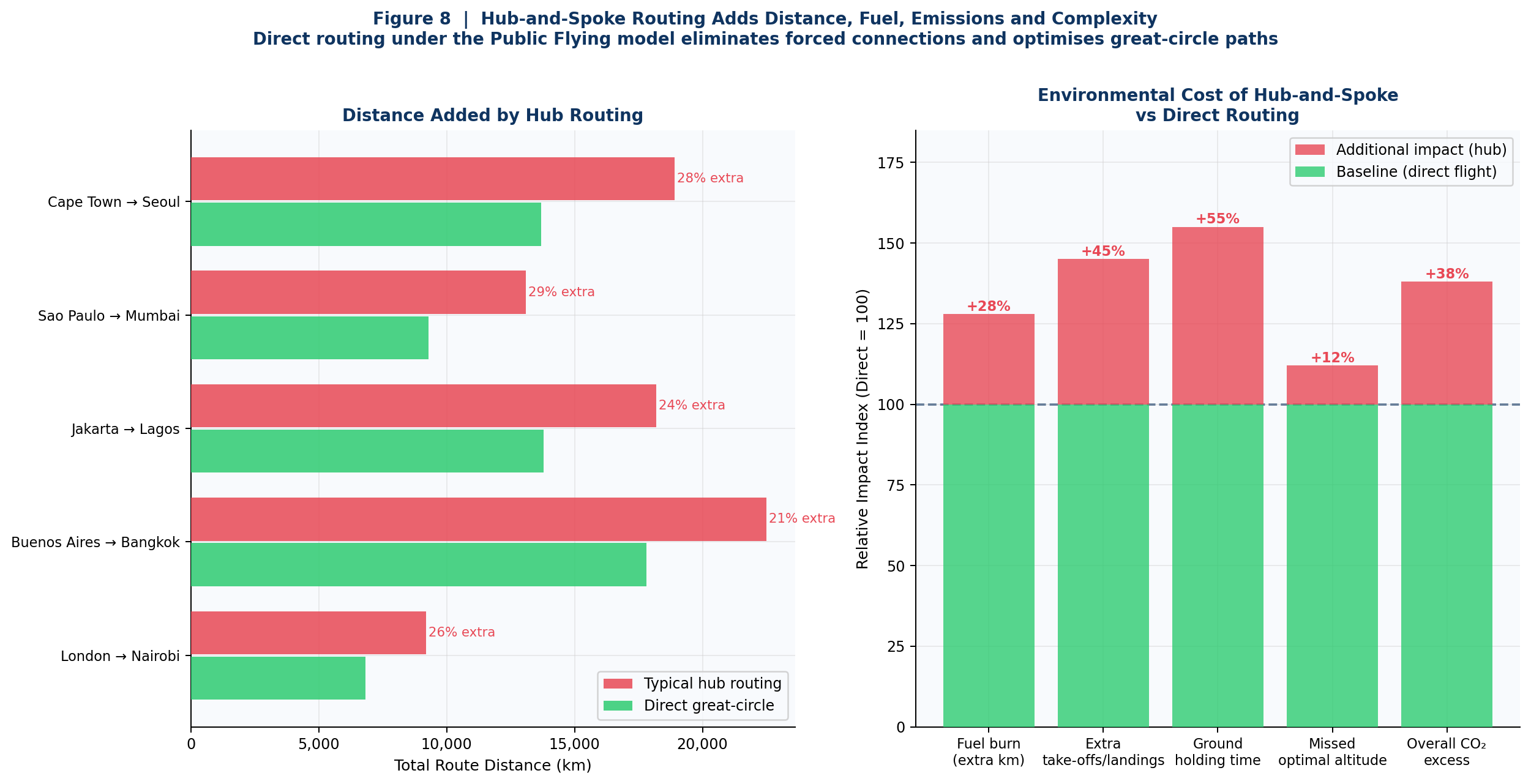
Hub-and-spoke exists because airlines profit from it. Passengers hate it. The planet hates it. Air traffic control hates it.
Under a fixed-fare model, there's no reason to force connections. Routes with demand get direct flights. Eliminate the unnecessary connections and global aviation emissions drop 15 to 25%, without changing a single piece of technology. Just by flying in straight lines.
Three rules. That's the whole framework.
Rule 1. Standardize the ticket. A ticket includes your seat, one checked bag up to 23kg, one carry-on, a meal, and all airport fees. No "basic economy." No baggage upcharge. No seat selection fee. The price you see is the price you pay. The Eurostar already does this. Every subway on Earth already does this. It's not complicated.
Rule 2. Cost-reflective fixed fares. A standard formula, published publicly, updated annually. Same route, same fare. Doesn't matter when you book or what device you search from. Last-minute travel costs the same as planning six months out. Carriers compete on reliability, cabin quality, on-time performance, route frequency. Not on who can extract the most money from a desperate traveler.
Rule 3. A Global Air Access Fund for thin routes. Some routes (small islands, remote regions) won't break even at standard fares. Fund those through a 1.5% levy on global airline revenue, about $14.5 billion a year. Carriers bid to operate the routes at the standard fare. Same way rural mail delivery works in every developed country. Same way rural broadband subsidies work. This isn't new. This is just applying a model that already exists.
- Your seatIncluded
- One checked bag, up to 23 kgIncluded
- One carry-onIncluded
- A mealIncluded
- All airport feesIncluded
The legal framework is already there. The Chicago Convention of 1944, the treaty that governs international aviation, already has the authority to standardize fares. It just hasn't been used.
This isn't socialism. It's how every other essential transport network on Earth already operates.
Last-minute pricing.
You need to fly home because someone in your family is sick. The ticket that was $300 a week ago is now $1,400. Same seat. Same flight. Same fuel cost.
- Flight
- Same
- Seat
- Same
- Fuel burned
- Same
- Crew
- Same
- Fare
- $1,400
$1,100 more for being in a hurry.
You're not paying for a service. You're paying for being in a hurry. The airline knows you have to fly, and they price-discriminate on your desperation.
That's not a market function. That's extraction.
And then, and this is the part that really gets me, you get on the plane and there are empty seats all around you. The flight is half full. The airline would rather fly a plane with empty seats than sell those seats at a price normal people can afford.
That's not capitalism failing. That's capitalism working exactly as designed, to maximize revenue per passenger, not passengers carried.
Subways don't do this. Trains don't do this. Buses don't do this. Only airlines.
The world is more connected than ever, and the price of staying connected keeps going up.
That's backwards.
Half the planet has a life that requires a plane to maintain. Refugees, migrants, expats, students, remote workers, families spread across three continents. You can't tell people to move where the opportunity is and then price them out of ever going back to see their family. You can't accept immigration and then trap people once they arrive. It can't be a one-way street.
If we're going to keep telling people the world is open, we have to make it actually reachable.
$290 to fly New York to London. That's the real price. Everything above that is the airline charging you for the fact that you didn't know.
Flying doesn't need to be free. It just needs rules.
Sources10
- American Airlines Just Mortgaged The AAdvantage Frequent Flyer Program For $5.5 Billion
- Is American Airlines' Loyalty Program Really Worth $31.5B?
- How CEO Ed Bastian built Delta's $8 billion per year partnership with American Express
- American Unveils Big Changes for Using Miles, Earning Status
- How Much Does It Cost An Airline To Produce A Frequent Flyer Mile?
- American Airlines Is Basically Break-Even — Its Loyalty Program Makes Billions While Flying Bleeds It All Away
- American Airlines and Citi Extend and Expand Co-Branded Card Partnership
- The History of ICAO and the Chicago Convention
- Airline Profitability Stabilizes with 3.9% Net Margin Expected in 2026
- Distance from Cape Town to Seoul (CPT – ICN)