









Tabula 26July 6, 20268 min
Bring Back Direct Democracy
The Greeks did it. The Swiss still do it. Modern technology makes it scalable. So why do we still let 500 people decide for 70 million?

Bring Back Direct Democracy
Once every four years, you vote.
You pick a name from a short list of people who almost certainly don't live in your city, don't know your neighborhood, and won't take your call. They go to a capital. They vote on hundreds of laws. They vote on wars. They vote on budgets in the billions. They vote on bills written by lobbyists you've never met for industries you don't work in.
You agree with maybe 30% of what they do. You disagree with maybe 40%. You don't even know about the rest.
This is what we call democracy in 2026. It is, in functional terms, four-year elective autocracy with a marketing department.
| Layer | Approximate count |
|---|---|
| Voters | ~50,000,000 |
| Elected representatives | ~600 |
| President / PM | 1 |
| Senior advisors | ~10 |
Modern "democracy" compresses millions of voters into a handful of decision-makers. The compression ratio is roughly 5 million to 1.
The compression, to scale
Drawn to scale: about 50,000,000 voters, about 600 elected representatives, about 10 senior advisors and one president or prime minister.
The original Greek model was direct. Every free citizen could attend the Assembly in Athens and voted personally on every major decision, war, peace, public expenditure, exile of officials. The Council of 500, which set the agenda, was selected by lot from the citizenry. Members rotated. No one accumulated permanent power. Decisions were executed by people who would go back to being farmers and craftsmen a year later.
But be honest about what Athens was. It was small. About 30,000 to 60,000 men held citizenship, in a region of maybe 250,000 to 300,000 people. Women, slaves and foreign residents had no vote. From 451 BC you needed two Athenian parents to be a citizen at all. So this was a small club of men who looked alike, prayed alike and could all walk to the same hill. They ran it with no printing press and no fast way to send a message.*
And it broke, more than once. Before the democracy, one family of tyrants ruled the city for most of 50 years. In 411 BC a group of 400 rich men took over in a coup. In 404 BC, after Athens lost its long war with Sparta, thirty men ruled by terror and killed about 1,500 citizens in less than a year. The crowd made its own disasters too. In 427 BC the Assembly voted to kill every man in the rebel city of Mytilene, then voted again the next day to take it back. In 406 BC it put six of its own winning generals to death. In 399 BC a jury of citizens killed Socrates.*
The structural principle was still sound. Citizens did not hand their power to a permanent class, and each time someone took it, they took it back. But Athens is proof that the idea can work. It is not a design you can copy.*
The Romans had a parallel structure. The Senate held aristocratic power, but the tribunes of the plebs could veto Senate decisions, propose laws directly to the people, and held the legal right of sacrosanctitas, they couldn't be harmed, and harming one was a capital offense. Consuls served one year only. Power was distributed, contested, time-limited.
On paper. In practice the men at the top kept inventing ways around it. They bought votes, and Rome kept passing new laws against bribery because the old ones never worked. They turned the veto into a weapon. In 133 BC the Senate's allies got one tribune to veto another, and that same year senators beat the reformer Tiberius Gracchus to death. In 59 BC a consul tried to cancel a whole year of laws by saying he was watching the sky for bad omens. The result was stalemate. Land and debt reform was fought for a century by the optimates, the Senate's conservative side.*
Stalemate turned into blood. Sulla marched an army on Rome in 88 BC. Caesar did it again in 49 BC, after the optimates ordered him to give up his army. The Republic lasted nearly five centuries, and its last one was civil war after civil war. It did not fall because the people had too much power. It fell because a small class learned to block everything, until the only man who could get anything done was a man with an army. That is the Empire, which is the form we somehow ended up copying.*
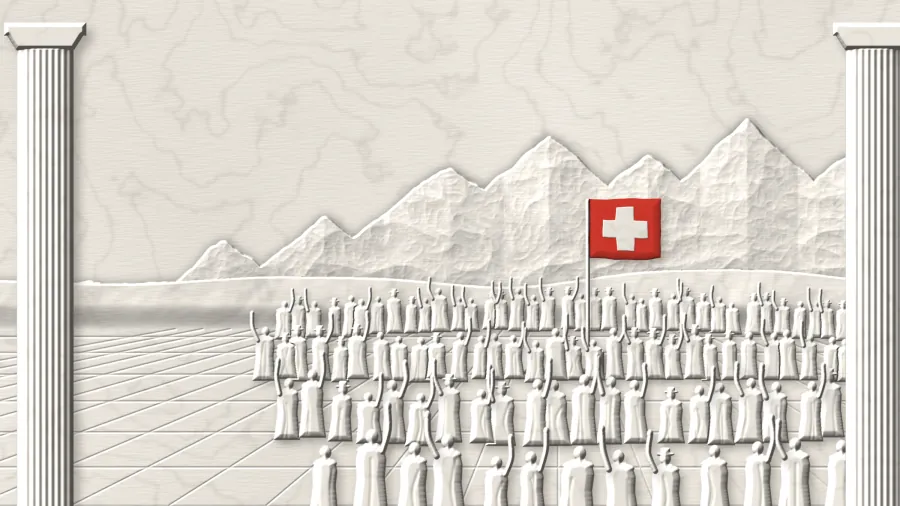
And then there's Switzerland, which has kept direct democracy alive into the modern era. In the cantons of Glarus and Appenzell Innerrhoden, citizens still gather in an open-air assembly, the landsgemeinde, and vote on laws by show of hands in the public square. At the federal level, Swiss citizens vote four times a year on referendums covering taxes, immigration, foreign treaties, constitutional changes, almost anything significant. Any citizen group can force a referendum on a new federal law by collecting 50,000 signatures in 100 days. The result: the Swiss government, more than any in the developed world, actually has to make policy that the population agrees with.
Force a referendum
0 / 50,000 signatures
Any citizen group can force a referendum on any law.
Federal votes
four times a year
We took the bad part of the Roman model, concentrated power in a small assembly of permanent professionals, and dropped the good part, the citizen veto.
You elect a representative. From the moment they take office, their incentives are no longer aligned with yours. They answer to:
The party machinery that controls their nomination for the next election.
The donors who fund their campaign.
The lobbyists who write the bills and explain them to staff.
The career officials in their department.
The leadership of their chamber, which controls committee assignments.
You are item number six on this list, at best. The system isn't broken in the sense that it doesn't work as designed. It's broken in that what it was designed for stopped serving the people about a century ago.
Here's the structure that's been floating around in democratic theory for decades. The underlying idea is sound.
One million citizens, four courses of stone
Still serving, for as long as they keep representing the people who chose them.
Every delegate is one step removed from the people who chose them. A recall vote opens when 5% of them ask for it. No one accumulates permanent power.
Citizens organize at the local level. Every 1,000 citizens elect one delegate from among themselves. The delegate isn't a politician, they're a neighbor with a job who took on a civic responsibility for a fixed term.
The 1,000 delegates from a region elect, among themselves, 100 delegates at the regional level. Same recall rules. Same time limits.
The 100 regional delegates from each region elect 10 at the national level. The 10 advise on national policy.
There is no permanent political class. There are no donors. There are no parties, or at most, loose affiliations. Every delegate is accountable directly to the people who chose them, and recall is always one step away. If a small share of the people who chose you, say 5%, sign against you, a recall vote opens. If most of them vote you out, you are removed. No election cycle. No waiting four years. Without recall, the system reverts to ordinary representation, which is what we have and which doesn't work. With recall, the incentive flips: delegates must continuously represent the actual views of their electors, because those electors can pull the rug at any moment.*
You don't have to look only at ancient history. Modern political theorists have been working on this.
Direct democracy, historical and modern attempts
508 BC
Athenian democracy founded
494 BC
Roman tribunes of the plebs
1231
First Swiss landsgemeinde (Uri)
1789
French Revolution pyramidal voting attempts
1977–2011
Libyan Jamahiriya (Gaddafi)
2002
Bryan Ford publishes Delegative Democracy
2010
German Pirate Party launches LiquidFeedback
2014
Estonia begins e-residency / digital democracy infrastructure
Liquid democracy is the academic name for a system where citizens can vote directly on any issue, or delegate their vote on a specific topic to someone they trust, and revoke that delegation at any time. The German Pirate Party was the first to run a working platform for this, LiquidFeedback, and used it for internal governance. Loomio in New Zealand built smaller-scale versions. Estonia has experimented with parts of this through its digital infrastructure.
Delegative democracy is a slightly different model where delegates carry the actual votes of the people who chose them, so a delegate representing 1,000 citizens casts 1,000 votes, not one. This makes accountability visible: you can see exactly how they voted on every issue, and whether they voted the way their electors wanted.
Both models address the central problem of representative democracy: representation, once given, can't be taken back fast enough to matter. The four-year cycle is too slow. The modern world produces important decisions every week.
This idea was attempted in Libya from 1977 onward under Muammar Gaddafi. His Green Book laid out a similar pyramidal structure of People's Congresses and People's Committees, with delegates revocable from below. Citizens were automatic members of their local congress. There were no political parties.
It didn't work, and the failure is instructive. Gaddafi maintained a parallel "Revolutionary Command" structure outside the formal democratic apparatus, controlling the military, security services, and oil revenue. The People's Congresses were real, but had no power over what actually mattered. The theory was sound. The implementation was hijacked.
The Green Book, as built
The lesson isn't that direct democracy doesn't work. It's that any version of it has to be designed with the assumption that someone will try to hollow it out from above. The Swiss model survives because there is no shadow Revolutionary Command. The Athenian model came back from two coups because its citizens would not let any one man become permanent. The formal structure isn't enough on its own.*
Most of what's broken in current politics traces back to the same root: decisions made by people who don't bear the consequences.
A representative votes for a war. They don't fight. Their children don't fight. They go home to a security detail.
A representative votes for a tax cut funded by debt. They retire on a pension before the bill comes due.
A representative votes for an environmental rollback. They live in a wealthy neighborhood unaffected by the pollution.
When the people making decisions have to live with the decisions, the decisions get better. Not perfect. Not always wise. But aligned, in a way that current representation simply isn't.
A neighbor who has to face the people they represent every week at the grocery store is going to vote very differently from a national legislator who flies home once a month. The accountability loop, currently broken, gets reconnected.
Real cost analysis. This isn't free. Direct democracy is slow on most issues. Foreign crises sometimes need a decision in twenty minutes, and consulting a thousand delegates can't deliver that. Some functions, defense in wartime, central bank operations, fast-moving regulatory responses, genuinely require small groups acting fast.
The fix is hybrid. Most decisions go through the pyramid. A defined small list, emergency response, certain technical regulation, monetary policy, stays with smaller bodies with sunset clauses and post-hoc citizen review. Most of the important decisions still go to the thousand.
The oldest objection is the strongest one. Give the crowd direct power and you get demagogues, then dictators. The American founders argued about exactly this. In 1776 Pennsylvania wrote the most radical constitution of the new states: one chamber, elected every year, no governor with a veto, and every public bill printed for the people and held until the next session, except in an emergency. Many founders hated it. James Madison wrote that pure democracies "have in general been as short in their lives as they have been violent in their deaths." Pennsylvania dropped its design in 1790. The United States got a Senate, a president and a four-year wait.*
They were right about the risk and wrong about the cure. Athens shows the risk: one good speaker and one angry afternoon. But the cure they chose was distance between the people and power, and that distance is the thing that rotted. The pyramid uses a different cure. Nobody speaks to a crowd of millions. A delegate speaks to people who know them. Big decisions get a second vote after a delay, the way Athens saved Mytilene and Pennsylvania made its bills wait.*
There's also the risk of populist whiplash. Direct democracy in the wrong configuration produces decisions like Brexit, popular votes on enormously complex issues without the institutional weight to think them through. The Swiss avoid this with a culture of small, frequent referendums that build civic literacy over time. They ask about ten national questions every year, and many more local ones, and the population gets practiced.
The current system is designed badly and doesn't represent the population. A direct system designed thoughtfully wouldn't be perfect, but it would close the gap between what people want and what their governments do.
We are running 21st-century societies on 18th-century governance technology. The American Constitution was written when getting information from a far state capital to the national capital took two weeks on horseback. Of course we delegated everything to a small group of professionals, there was no other choice.
That constraint is gone. Every citizen has more communication infrastructure in their pocket than the entire United States government had in 1850. Decisions that used to require months of physical travel and printed pamphlets can now be made by millions in an afternoon, with deliberation, accurate information, and traceable accountability.
The technology is here. The theoretical models are here. The historical precedents, Athens, Rome, Switzerland, are here. What's missing is the political will to build it, because the people who currently hold power are exactly the people who would lose it.
Direct democracy is not a fantasy. It's a question of whether we want to keep paying a permanent political class to make our decisions for us, or whether we want to start making them ourselves.
The Greeks figured this out 2,500 years ago. We can probably manage it too.