


Field note 01January 12, 20262 min
The Living SoilWhy What's Beneath Your Feet Matters More Than You Think
Soil isn't just dirt, it's a complex ecosystem teeming with billions of microorganisms. Understanding the biology beneath our feet could be the key to more resilient, productive agriculture.

The Living SoilWhy What's Beneath Your Feet Matters More Than You Think
Most people think of soil as inert ground, the stuff you walk on, that plants grow in, that gets muddy when it rains. The reality is far more interesting, and far more important.
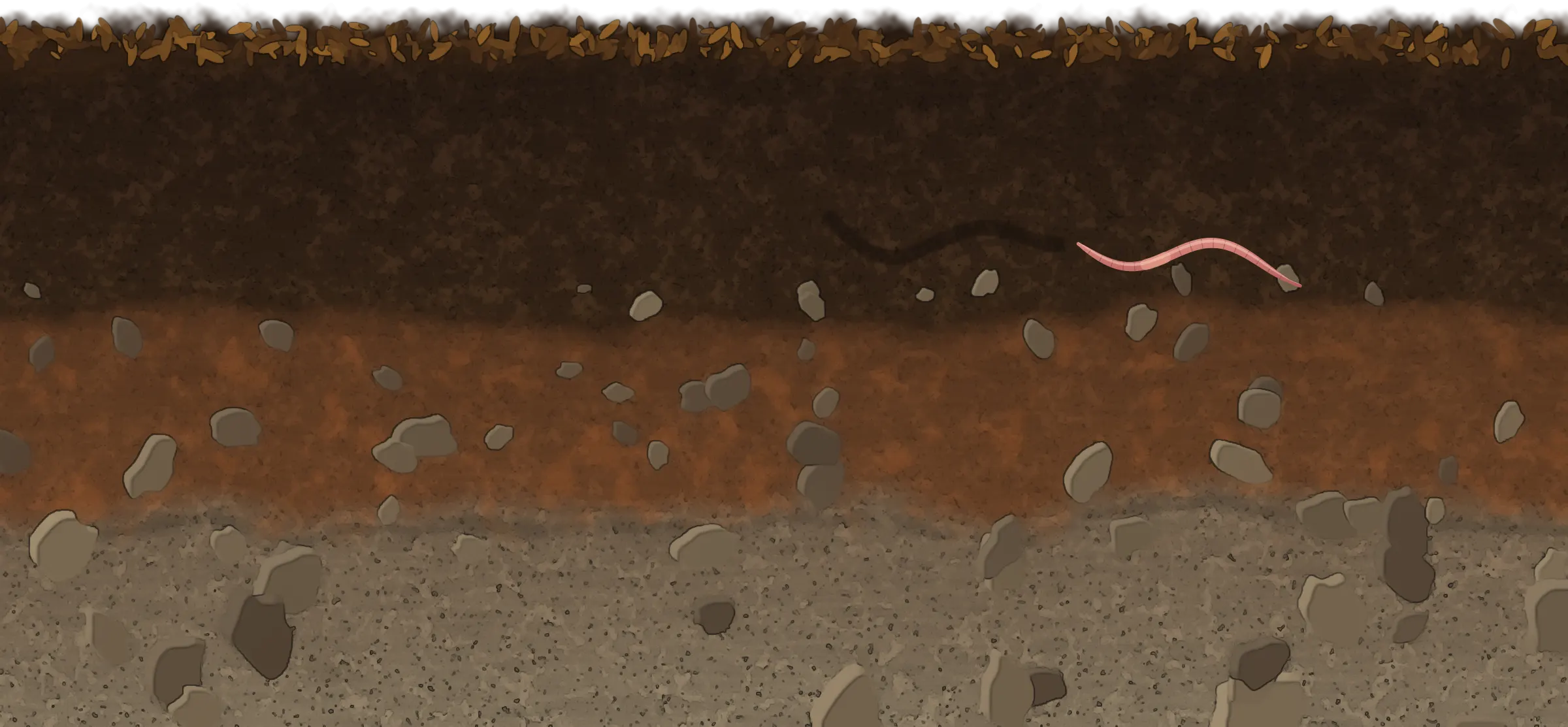
A single teaspoon of healthy agricultural soil contains more microorganisms than there are people on Earth. Bacteria, fungi, protozoa, nematodes, and arthropods form an intricate web of interactions that shapes plant health, water retention, carbon storage, and nutrient cycling. When we talk about "healthy soil," we're really talking about the health of this invisible ecosystem.
Move the lens
It holds more microorganisms than there are people on Earth. Drag the lens, or pick a group.
The concept of the soil food web was popularized by soil ecologist Elaine Ingham in the 1980s and 90s. The basic idea: every organism in the soil is eating something, and being eaten by something else. Bacteria decompose organic matter; protozoa eat bacteria and release nitrogen in plant-available forms; fungi form symbiotic relationships with plant roots to extend their effective reach for water and phosphorus.
Tap any member of the web.
This web is self-regulating in healthy soils. Disturbances, tillage, synthetic fertilizers, pesticides, can collapse parts of it, leading to a cascade of consequences: reduced water infiltration, increased erosion, higher fertilizer requirements (because the biological nutrient cycle is disrupted), and less resilient crops.
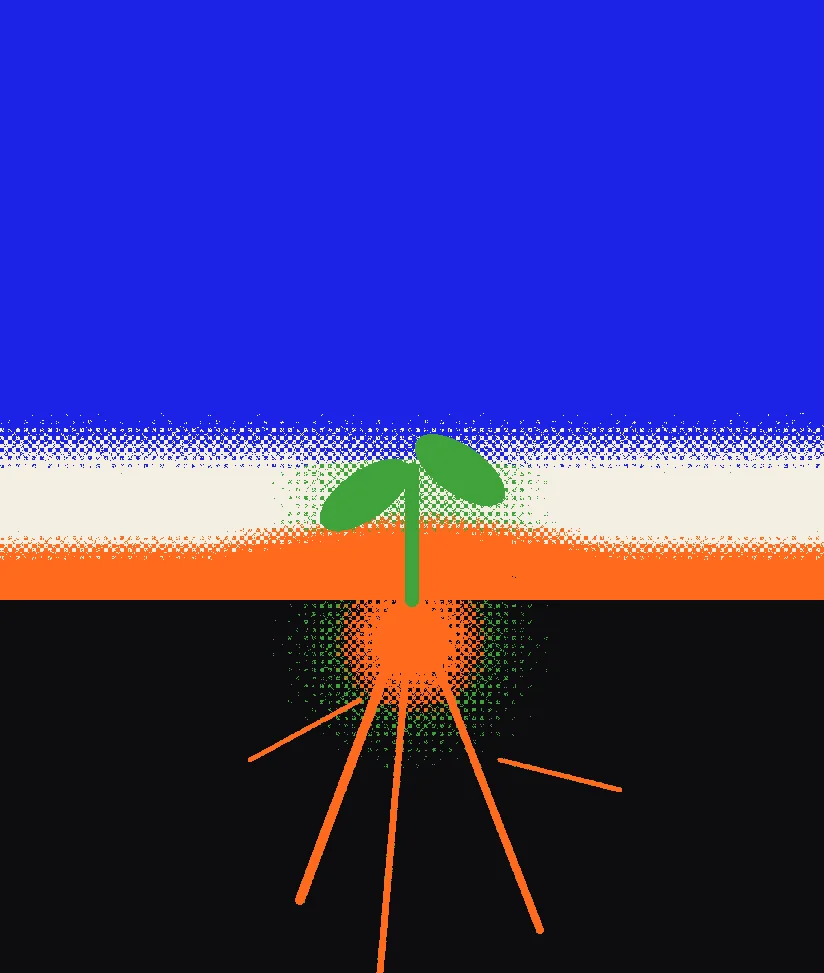
One of the most remarkable relationships in soil biology is the mycorrhizal association between fungi and plant roots. Over 90% of land plants form these partnerships. The fungus extends filaments called hyphae far beyond the root zone, effectively multiplying the plant's surface area for nutrient and water uptake by orders of magnitude.
In return, the plant feeds the fungus carbon, up to 30% of photosynthetically fixed carbon in some species flows directly to mycorrhizal partners. It's an expensive partnership, but the trade-off is worth it: plants with intact mycorrhizal networks are measurably more drought-tolerant, disease-resistant, and phosphorus-efficient.
The catch? Synthetic phosphorus fertilizers suppress mycorrhizal colonization. When phosphorus is abundant, the plant has no incentive to maintain the energetically expensive partnership. This is one reason why conventional high-input agriculture creates a dependency cycle: you disrupt the biology, so you need more inputs, which further disrupts the biology.
For the last century, agricultural soil was valued almost entirely by its chemical composition, nitrogen, phosphorus, potassium, and pH. Soil organic matter (SOM) was noted, but rarely the primary focus.
That's changing. Soil organic carbon is now understood to be central to almost every aspect of soil function. Higher SOM means:
- Better water-holding capacity (each 1% increase in SOM allows soil to hold roughly 20,000 gallons more water per acre)
- More microbial activity and diversity
- Improved aggregation (soil structure)
- Long-term fertility
+20,000gallons of water per acre
Regenerative agriculture practices, cover cropping, reduced tillage, compost application, diverse rotations, are fundamentally about building organic matter. It's a slower, less immediately measurable approach than applying a fertilizer bag, but the compounding returns over years and decades are substantial.
If you manage any piece of land, a farm, a garden, a backyard, a few principles go a long way:
-
Minimize soil disturbance. Every time you till, you shatter fungal networks and oxidize organic matter. If you can no-till or reduce tillage frequency, the biology will thank you.
-
Keep the soil covered. Bare soil is biologically inert and erosion-prone. Cover crops, mulch, or even weeds are better than nothing.
-
Feed the biology, not just the plant. Compost, manures, and green mulches feed the microbial community. Chemical fertilizers feed the plant but often bypass or suppress the biology.
-
Be patient. Rebuilding soil biology after intensive management takes years, not weeks. But the trajectory matters more than the starting point.
The soil is doing enormous work for us, mostly invisible and mostly for free. Understanding that work is the first step toward managing land in a way that doesn't spend down that capital faster than it accumulates.
Sources06
- Uncovering the Hidden Life of Soil
- Obituary for Dr. Elaine Ingham
- Evolution of mycorrhizas in land plants
- The Phosphate Inhibition Paradigm: Host and Fungal Genotypes Determine Arbuscular Mycorrhizal Fungal Colonization and Responsiveness to Inoculation in Cassava With Increasing Phosphorus Supply
- SS661/SL447: Raising Soil Organic Matter Content to Improve Water Holding Capacity
- Does 1% Organic Matter Hold 20,000 Gallons? Debunking the 20,000-gallons claim